
Step Behind The Stage
Shake-Scene Shakespeare's Much Ado About Nothing
Hilldrop Community Centre, London - 05/07/2026
Review by Alex King
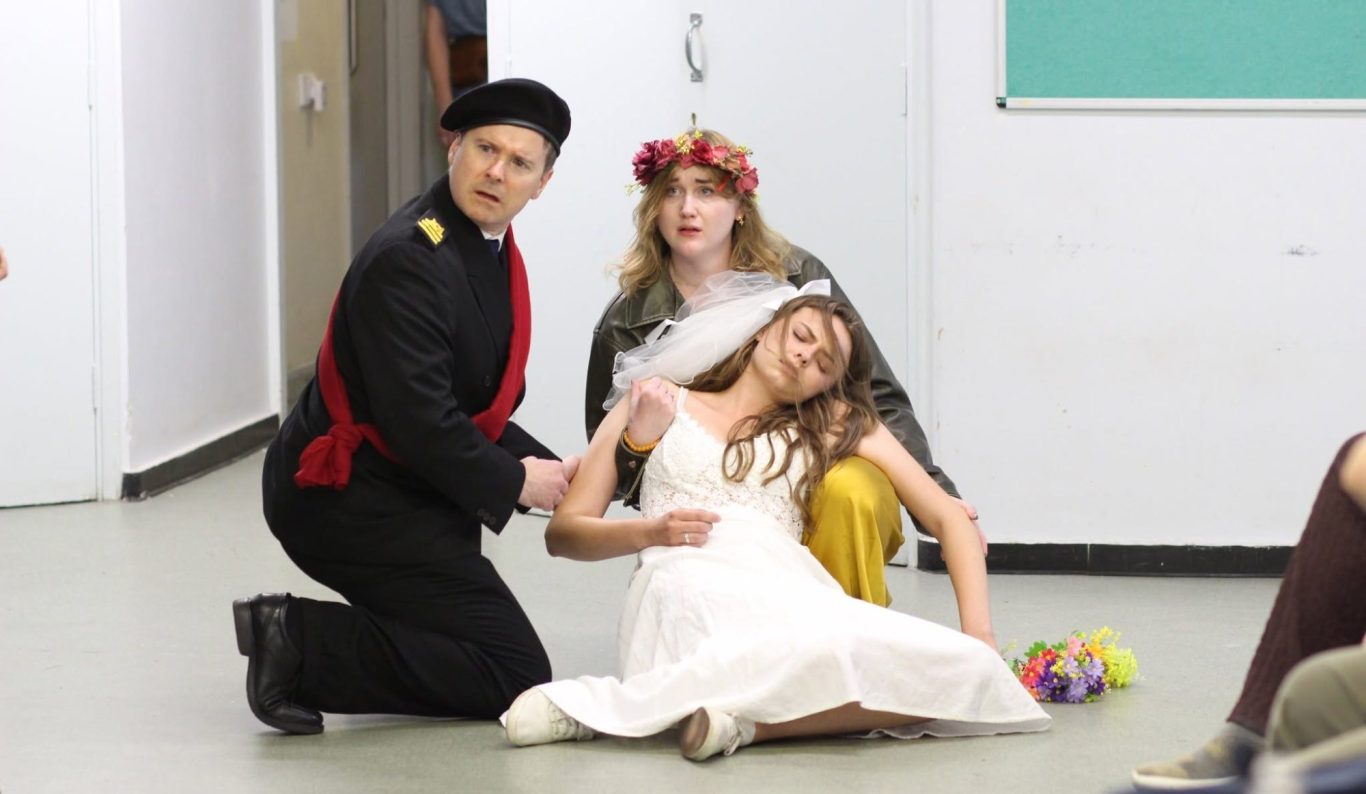
Photo Credit: Production
For the past few years, Shake-scene has blended the tradition of cue-script and their own style of reinvention of William Shakespeare’s work. With no group rehearsal or direction, the performers learn only their individual lines and cues and form their interpretation of the characters on their own and only when the curtain rises does the production finally come to life. Set against the backdrop of a community centre kitchen, their most recent performance occurred at the Hilldrop Community Centre this past Sunday. The event was a fundraising performance for the amazing work the centre does, so we would really urge you to have a look at the centre's website and consider donating if you can.
Before starting, we were warmly welcomed by an enthusiastic prologue by artistic director Lizzie Conrad Hughes. Full of rhyming couplets, it served as an inviting opening for the following performance and explained the self-professed “rules of the game”. Cues may be missed, characters will unfold, and the occasional “line” may be requested, all of which are staples of this historic style. After introducing the cast and the instruction of “starting cues”, the play got underway.
What shshshahahaque experience of the famed comedy. While the cast’s familiarity with one another makes for immediately clear chemistry between characters, there is still a period of feeling out one another, understanding the dynamics and ways in which the cast have taken their characters. Watching this usually hidden exercise was fascinating to watch play out on stage as, over the course of the play, you watched performers find one another as they gain confidence in their relationships within the narrative. With Much Ado, this was especially interesting to watch as the story is so heavily tied to the two relationships involved.
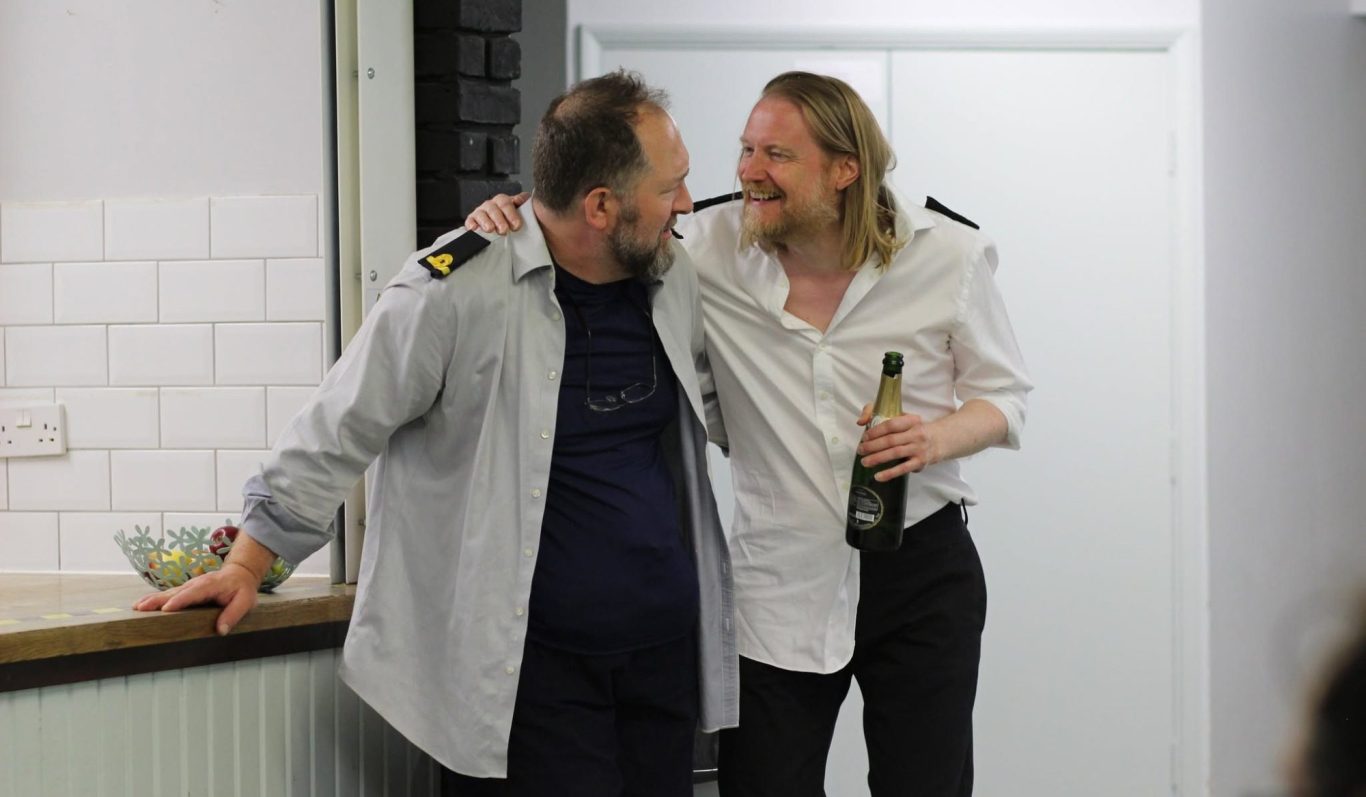
Photo Credit: Production
Something that is undoubtedly clear is that no rehearsal does not deliver a weaker performance for a comedy or drama. Distinct praise must be given to Isla McLeod’s wonderfully silly and loud dialogue and Matt Williams' drunken Borachio was a joy to watch. Taking on the primary roles were Dewi Hughes and Kate Andrews, as Benedick and Beatrice respectively, who were both thoroughly entertaining in their roles and brought charm, anger, vulnerability and humour to their roles. The pair's chemistry was immediately evident and only strengthened as both found their paths through the play, another example of what makes cue-script so unique. Equally talented were Halli Pattison and Larissa Oates as Hero and Claudio, who brought a sweet and tenderness to their relationship.
What was so evident to me as an audience member was the understanding of comedy which was showcased richly throughout. Aside from the dialogue, the production was rife with physical comedy, visual jokes, and facial expressions, all that would have been born purely from the minds of the individual actors.
What makes this style of performance so special is the spontaneity of it all. In the best way possible, this feels like a production that sprang from a toybox. A collection of talented performers digging through to find costumes to find what works best, props that do that, while they aren’t the most expensive, still get the point across, and at the end of it all, putting on a performance that is full of passion and excitement for telling stories.
Cast on the Night:
Kate Andrews - Beatrice
Tom Barnes - Verges/Friar
Geraldine Brennan - Dogberry
Dewi Hughes - Benedick
Lizzie Huxley - Don Jon/Margaret
Alexandra Kataigida - Don Pedro
Tim Klotz - Conrade
Isla McLeod - Messenger/Ursula/Watch
Larissa Oates - Claudio
Halli Pattison - Hero
Iain Peacock - Leonato
Matt Williams – Borachio
Lizzie Conrad Hughes - Bookholder
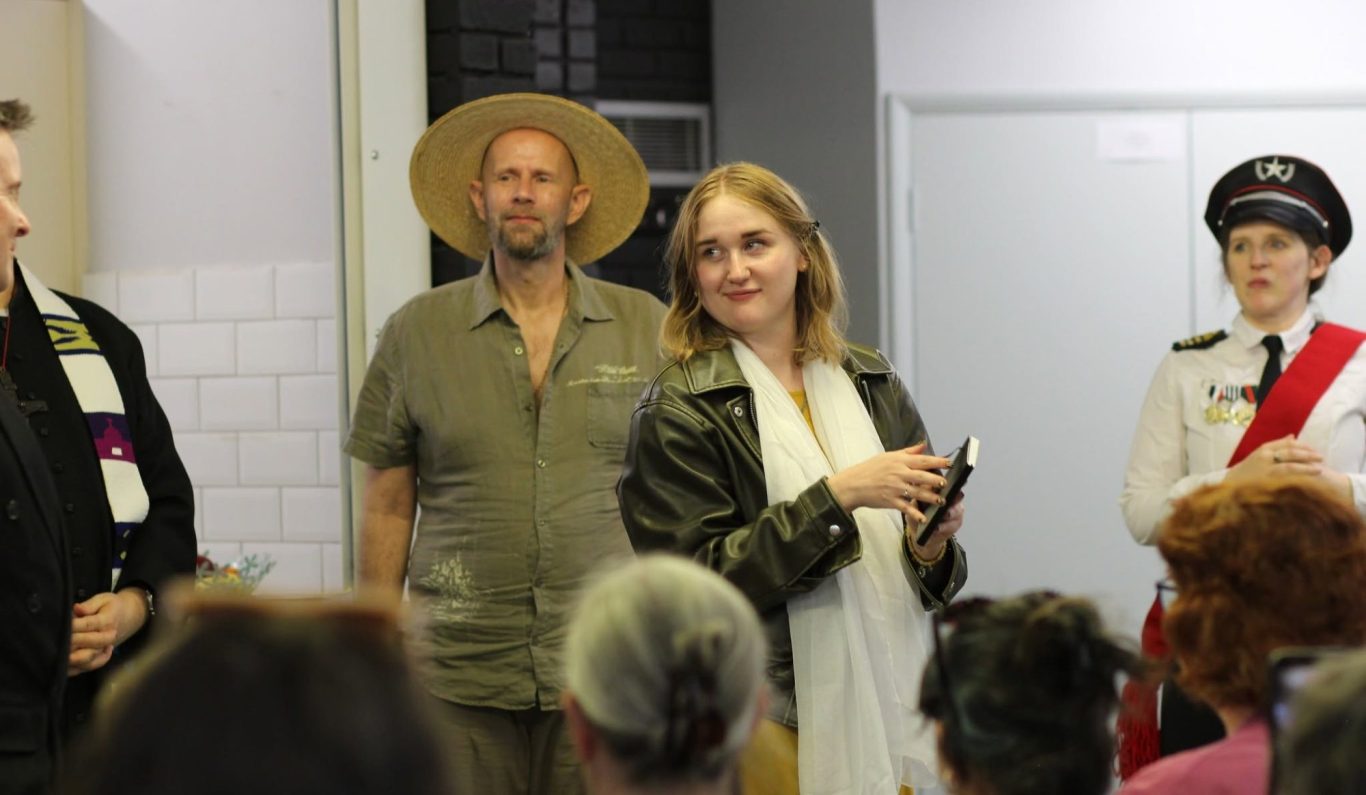
Photo Credit: Production
After the production I had the chance to catch up with Artistic Director and Bookholder Lizzie Conrad Hughes as well as Beatrice herself, Kate Andrews, to discuss what makes Shake-scene so special what it means to them as people.
Lizzie: "It's basically all my fault. Entirely my fault. I started out life as an English graduate. I have a very boring English Literature degree. I was a school teacher and then I kind of had one of those moments where I go, what the hell am I doing? I never wanted to do this. I wanted to be an actor. So I chucked out teaching, went on the stage, been an actor for 20 odd years. But because I had the English literature thing together with the acting thing, I was working with a group and people started saying, you should teach Shakespeare to actors. To which I said something rather rude. It's like, I don't know any more than anybody else. But then I did start teaching and that made me want to read and the more I read, the more I found out, and I fell over this book. A book called 'The Secrets of Acting Shakespeare' by Patrick Tucker and I thought, well, I'd better read that. Patrick Tucker was basically the person who created this modern radical technique. It is historically informed, that's how we talk about it. But it's not a direct sort of recreation of the past, it never could be. But it's based on what at the time was known about the technique and how it worked. Because Patrick Tucker was involved with the creation of the Wanamaker Globe. They were all in a room talking about what original stuff they were going to do, because it was the creation of original practices, and they wanted original fabric and original clothes and original dancing and original music. And somebody said, 'why shouldn't we do original rehearsal, original preparation?' And the story is told that everybody looked around and nobody knew because nobody had ever rehearsed it.
So Patrick Tucker, who was the director of stage and screen, basically went, right, that's me then, I'm going to go sort that out. And he went to the Dulwich College archive, where they have three very key documents. They have the one that we know of surviving professional part from this era, which is completely mental because I did work out what the numbers were. There must have been hundreds of thousands. We know of one professional part for one character. One play. Not even Shakespeare. And it's a part for Orlando Furioso. So he looked at that part, at how it was structured and the information that was in it. And he looked at Philip Henslowe's diary. So Philip Henslowe used to run the Rose Theatre, which was the first one built on the South Bank. And we have his diary in big air quotes because it's really just where he wrote down all kinds of crap that was going on during the day. So he wrote down box office takings. He wrote notes to people. He wrote lists of who owed him money. But he did write down schedules of what money was made by what company for what play on what day. It's not fully reliable. There's allegedly a 31st of February somewhere in it. So you have to be a little bit careful with Henslowe, but basically what you see is a different play every day. So Patrick Tucker took differently, seeing there was a different play every day, and he thought there was no room for a rehearsal process, as we understand it.
Therefore, they did not rehearse. So he went with this entire idea of it being entirely spontaneous and that you would get your part the night before. That you would go home, you would learn it, which is sort of based on, there are lots of references in plays of the time of actors not knowing their part and not knowing who's playing who. They're mostly comedies. So, you know, we have to be a bit careful with that. But that was the evidence. And so he went, and he looked at how parts worked, and he looked at how the language worked, and he started doing workshops on the basis that all you needed was your lines and your cues. You didn't need anything else. And the idea was that their idea of acting was founded on spontaneity, the discovery in the moment of A who was giving you your line and B what it was and C how it came to you. Then, when the actor was surprised, then the character was supposed to be surprised. And when the actor was shocked, then the character was supposed to be shocked. So that was his theory and he ran a company for some years in the 90s into the noughties, The Original Shakespeare Company, and that resulted in this book. From that, I read that book and my brain exploded all over the wall. This is phenomenal. I want to do this so passionately because I love Shakespeare and I frequently get bored. And one thing you can't be there is you're never bored. You're shocked, horrified, delighted but never bored. And I thought this was it. This is real Shakespeare with like discovery moments and surprise moments and human moments and poetry. I just got very excited because I was an actor. All my friends are actors. So we did some workshops, and we had a lot of disasters, and we did more reading, and we did more workshops and we sort of read and built and read and built, and over about two or three years it became Shake-scene. This is my thing now and that is what we are based on. Last year I completed a doctorate which was inspired by this work. So I've done more research into it than Patrick Tucker did and there are more things to be revealed in the technique which we're working on at the moment."
Alex: "It's lovely to have such a rich history. It really celebrates the spontaneity that's so present in the production. I think it's just so lovely when you see someone so passionate, it translates onto the stage."
Lizzie: "Thank you for that. It endlessly amazes me that fabulous people trust me with this mad idea. It's like, hey guys, let's do a play and not rehearse it. And everybody goes, yes, that's a good idea. And you're like, okay, you lot are more bonkers than I am. But yeah, it still surprises me that the guys want to do it. If they didn't, there would obviously be nothing. So it's not me, it's them. Those are the people that come that want to make it happen. And because they want to make it happen, and they love playing with each other, it's the essence of play. You have to be playful. You [Kate] didn't know how Dewi was going to play with you as"
Kate: "No, I was very surprised frequently."
Alex: "As a performer, what first got you into this?"
Kate: "I first did this technique in 2018. I went to one of Lizzie's workshops. I didn't know her or anyone, or what it was. But I am just mad into Shakespeare. So I was like, oh, a new interesting Shakespeare thing that I'd never heard of. And I just fell in love with it because it's exactly so humanising. With Shakespeare, you're trained to do it in such an often very elitist way and in such a rule-bound way, like almost all technique and no humanity, which is why people are scared of it. And I wasn't scared of it, but I was bound by those rules, and it's unlocked the humanity. That's why I like it in the first place in the performance of it."
Alex: "Apart from the lack of rehearsal, what's the main difference for you as a performer?"
Kate: "Well, exactly the same as entering a social interaction in real life, you only know yourself what you want, what your traits are, and what you're going to say. Which sometimes even that doesn't go to plan. You don't know how other people are going to react, what they're going to do, what their opinions are of you. What's even going to happen, which is exactly like real life. How I prepare is, I record the cues on audio with space for my lines, play them in order, looking at the script and doing the lines, not acting. And then, after a while, I can put away the script and I can still do that. After a while, I can cut up the audio and do it at random intervals. Then I can rehearse with a friend where they read the cues correctly, then I rehearse with a friend where they read the cues really wrong and like with other words before them and stuff. And that's how I feel secure enough to then, on the day of it and the day before, just completely let go, not practice and just go in, which is something I couldn't do before I did this technique with any play, even when it was rehearsed."
Alex: "You must have a lot of trust in your cast?"
Lizzie: "Trust is huge. It's in each other and it's in the text. Because we do have a lot of, well, not rules, but there's a lot of sorts of principles about how you handle what you find in your text. But at the same time, you don't know how it's going to play. I mean, I have this thing in my head that if you think of parts, but it's like parts of an engine. So you have different parts of an engine, so you've got a spark plug, and you've got a fuel gauge, and you've got a fan belt, and you've got an air filter. And if those parts are fully prepared and able to do their thing, then the entire machine works. But they have no idea what the other parts do. And I find that really fascinating because, basically, for example, Kate just prepared Beatrice and she just came on stage ready to Beatrice. Basically, your job is to bring onto stage what you believe your character is bringing to the scene. I mean, you have an idea from the arc of your lines. You sometimes have a giveaway of, like, you're angry with someone, or I don't know what happens, but there's a big change at this point. Maybe someone else has come in. So you have a responsibility to get the line of the part through, but exactly how you're getting from A to B to C, you don't know until you do it. That's where the trust comes in. But the essential thing is that you just have to Beatrice. You had to Beatrice all the way through."
Kate: "[Jokes] It was actually fine because I didn't have to do any acting."
Lizzie: "Yes, she did."
Kate: "Well, I did a bit."
Lizzie: "I was going to say, you better, because Dewi is my husband."
Kate: "Oh, no, I wasn't method acting! Only that personality type, of course. That's why you trusted me to play it. I was going to say about the engine thing. So we use a first folio text because you can interpret that, and I believe that it's got clues in it for the actors. So I don't think that the funky punctuation is printing errors, as I think it's there to be like 'maybe you breathe here.'
And then you can try it and see what happens. So even people with the same part, as Valentina [Vinci] is working on it at the same time, playing Beatrice next with Shakescene, and we're going to make different discoveries and the way we build out the same engine parts is going to be different because it's what hooks onto you from those very technical things that are all you have to prepare."
Lizzie: "One of the frustrating things is people say to us, well everybody knows Shakespeare, so nobody's surprised. To me, that's people who've never done it. Because one, the edit is different. This was a 90-minute edit we just did. So I cut it to shreds and I did a lot of violence to my feelings in the same way, because I love this play. But the rhythm of the edit is very specific. So the rhythm of the whole play is different. So the minute you edit it, it's a different play. And then you put it through different people, it's a different play again. The second play that I ever staged using this technique was The Tempest and I played Prospero and I always use this as an example because I did The Tempest for A-level which was a long time ago, and so I know it very well. I've seen it probably upwards of 20 times in my life. It was the first Shakespeare I ever saw because it's a play I like very much. And I was on stage as Prospero, having done the edit, having cut the parts. I avoided doing any sort of text prep work with any actors that I was in scenes with. But I remember vividly being on stage with Alonso in the last scene and going, what the hell are you saying? Where is that in the play? It just does something to your head. And I wish I knew a lot more about how the brain works, because I don't understand why or what. I just know it does something to your head, and you don't know what you know. I mean that's also partly why I'm there as book holder. It's not because I don't trust them that they haven't learnt their lines. I know bloody well that they have.
But I also know that under pressure, without group rehearsal, a thing that is very likely to happen is that lines get lost. And in Shakespeare's own time, the prompter was absolutely ingrained as a voice that was part of going to a play. The invisible but audible prompter was such a common factor of all kinds of writing at the time. We have a sense of shame about being prompted, and it's something that we, as actors doing this technique, have to actively kind of grow out of because there is no shame in this technique. You're doing something incredibly highly pressured with none of the support that you get from doing a group rehearsal process. You get a bunch of other stuff, but you don't have stuff that you're used to. So the first thing that happens is your lines go. And I know this, and I've been on stage playing Prospero and I thought I knew my lines, and I'm there going 'Nope, it's gone'."
Kate: "It's part of the game as well, because the audience quite like it. It makes me kind of sad because that's not the thing that I forget. I forget when to leave the scene. My main thing is I have to be told to leave, but it can be funny. It also makes me so relaxed when I'm on a job that has rehearsal, because everyone's like, oh, we only got three weeks. And I'm like, I do it without. It makes me very relaxed when it's got, when it comes with that structure, but also there's nothing as exhilarating as doing it this way."
Lizzie: "Yeah, they have had their parts for months, but I give them as long as possible with their parts so that they've got plenty of time and they get one-to-one preparation sessions with me if they ask for them, which can be anything from what does this line mean, to how do I say this word"
Kate: "To like therapy for the character. That's what mine are like."
Lizzie: "Yeah, it's all about finding that background."
Alex: "And how much insight do you [Lizzie] give prior to the performance about what it looks like for you?"
Lizzie: "Oh golly. Well, I do the edit, so my job happens at the beginning. I work out the circuit of who's entering where and when so that they don't have to prepare that, which is not historical, but it makes sense, because you need to decide it one way or the other. And then, basically, I let them get on with it, and they just know that I'm there if they want them. If we have a particular look in mind, or we need a colour scheme, if people have to coordinate, things like that we'll talk about. Questions will come up, but I've worked with these guys a lot. I mean you [Kate] joined us, when was it? 2018?"
Kate: "Yeah"
Lizzie: "And we did a lot during lockdown. You know, it took us three years of online theatre because people don't want to stop working. We've had the opportunity to do this a lot. And people that have worked with me for a while. I trust them, and I know their process. I know they'll come to me if they want me and I trust them not to. And no, I get surprised as well.
Sometimes because they plan things and sometimes because I know about them and sometimes because I don't and then things happen. So sometimes they get me as well. That's just part of the joy. I mean, we did have a cigarette gag built into this one, but I didn't know when you were going to do it."
Kate: "I didn't know when I was going to do it."
Lizzie: "No, but you just did it when it felt good. When it feels right. Purists will probably say that we shouldn't ever monkey with the text. But a Shakespeare comedy would have been full of things like that. So it's true to the spirit of [the original plays] and it entertained the audience. And the bottom line is our job is to entertain our audience. If we're not entertaining our audience, we shouldn't be doing it. You don't do it to suit yourselves. You don't do it for academic reasons. We entertained an audience. That was our job. I always start with that introduction so that people are very clear, this is the thing that's going to happen. This is how we are doing it. I bring the actors on at the beginning because it's all scenes from the outside. You know, we have no fourth wall. There's no artificial sort of barrier between us and them. Actors are going to do a play. And we're very clear about that. Actors are going to do a play and I introduce them to me so that they understand who I am, what I'm doing and why I chip in. Because it's not something that we're familiar with. Although every now again, people start sharing stories about when they've heard other people being prompted when they weren't doing this technique. It's rare. We don't expect it. We are shocked when it happens."
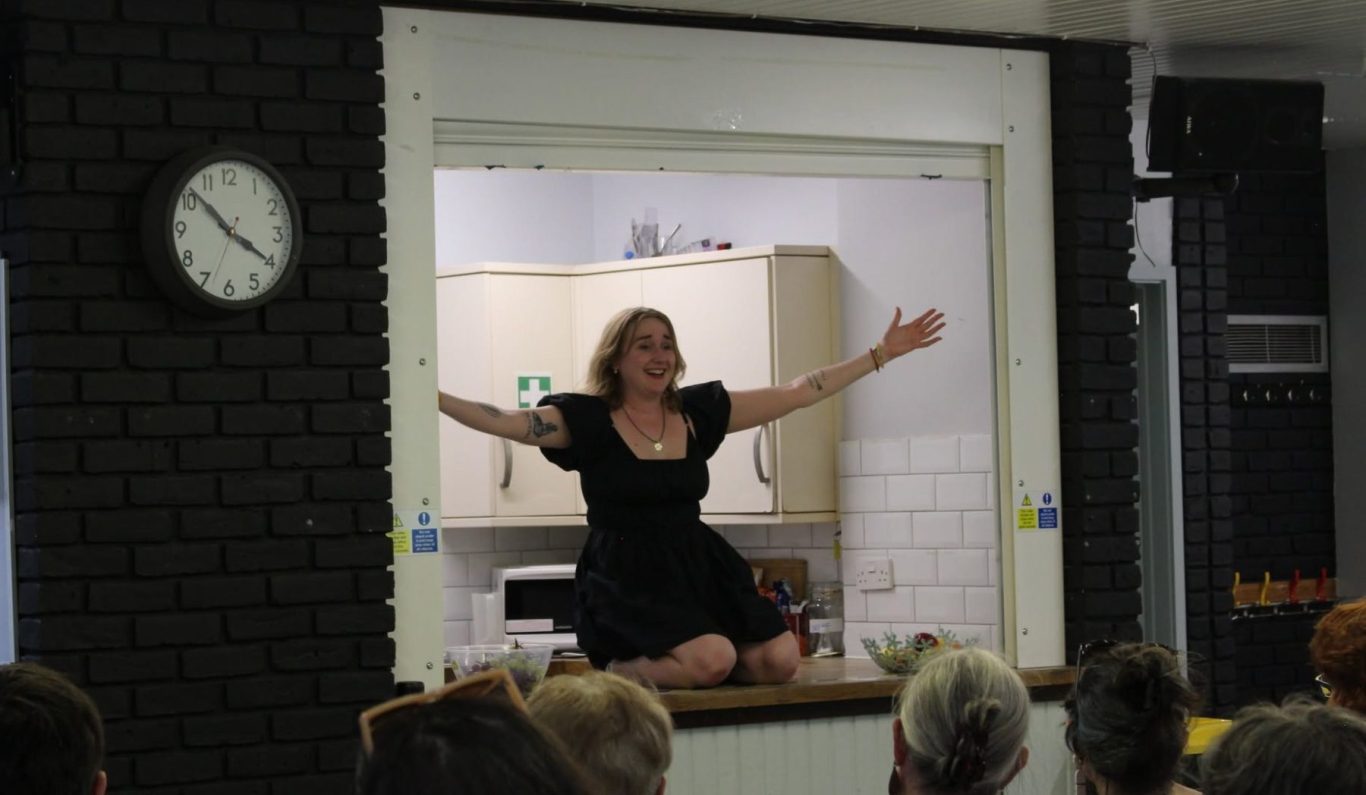
Photo Credit: Production
Alex: "Yeah and something else you've got a very strong point about is inclusivity and accessibility. I think that's a really important thing in theatre at the moment. What's, for you and the company in general, the driving force behind that.
Lizzie: Well, my fundamental belief is that Shakespeare is for everyone. Anytime I come across anybody who says oh Shakespeare's not for me, I'm 'too whatever'. That physically hurts me. Because I'm like, no, he was a man of the people. He wrote for the people. This is for you. I don't care who you are. It's for you. And so, from that point of view, it's always important to us. I mean, we're always scrabbling to keep up. I'm not saying we're perfect, but you know, we have actors who are physically disabled who work with us. We have many, many neurodivergent actors because we're sort of discovering stuff all the time. It just delights me that we can go on doing that. We love working in a space that's physically accessible."
Kate: "Yeah, I didn't mean to go into access as work, but then, because there wasn't accessithisbility in many companies, unlike one, I ended up doing it so that I could do the jobs. But I've always found this technique more accessible than most traditional Shakespeare rooms, even though I don't find Shakespeare difficult or off-putting. I also feel that, like Shakespeare as we know it now, you'll hear people go, 'Oh, Shakespeare is posh and like elitist'. It wasn't originally. It's been intentionally gentrified by the ruling class. And doing a technique like this is taking it away from that and giving it to the people and the audience, which is why it matters so much to me. I think that this technique works specifically well for me and that I'm specifically good at it because I'm autistic. I think there's something about it that I didn't know I was when I started it. I was diagnosed in 2021. But I find it much more accessible to me than certain means of rehearsing, where, like, for example, in this, because it's not rehearsed, the fighting intimacy calls are given real importance, because we do rehearse those things, we do stage them so that it's safe. Whereas when I started acting 11 years ago, it would just be sort of like, you go outside to some other room and just like figure out a kiss. And I always found that as dreadfully socially awkward. Whereas in this it's like you can do a lot alone, which also means you've got more energy to give into the performance. But then it's with people that you trust from having learnt the technique together, and you know you're safe with them, so you can go to places that you couldn't necessarily go."
Lizzie: "And we do have people who are trained in intimacy and physicality and stuff, and you're [Kate] one of them. I am in the process of putting together a post-doctoral research project, because I want to do lots more work on this, specifically with neurodivergence. Because I think it has enormous potential for really levelling the teaching and the rehearsal and the accessibility for actors, partly through conversations that I've had with Kate and some of the other members of the company, but I've also discovered through doing this that I am AuDHD. And my whole life, I never knew that. I think possibly this is one of the reasons that I am so attracted to this. One of our other members who has ADHD, when I was interviewed about this, she said, I really like the way that you explain it and the way you structure it and the way you sort of do the teaching. I was like, Oh, I do it the way it makes sense to me. And then, you know, through doing a lot of research into autism and ADHD at the moment, because of putting this project together. So, yeah, I don't know where it will go, but very, very excited and hopeful for that in the years to come. I mean, in the meantime, we ain't stopping doing the plays."
Kate: "And Much Ado About Nothing specifically, I asked to play Beatrice because I feel really strongly about this character. Anyone can do it and will be brilliant. But I've never seen my personality represented in anything. And still there's like two autistic TV shows. There's nothing wrong with being the stereotype. But they are this stereotype of autism as a certain type of quiet, well-behaved asexual person, and it's wonderful if you are those things. I'm not, and I am AuDHD. I've never seen it represented. I've never seen that love involves vulnerability and that is scary to someone for whom, because they're different, vulnerability can be dangerous. And I've never seen that represented in anything except this play. And that's why I care so much about doing this play. I never go into things in an intended way. I'm going to make some autistic, but then also I don't switch it off because I can't. But with this, I was like, I do want to make it, have some nods in there to make it a bit more explicit, like the reading and the ear defenders, because this is a happy, attractive character that ends the play in healthy relationship and happens to be autistic and that matters to me to the extreme because the reason that some three and four of us will experience violence before we get that happy ending or if we do is because of the lack of representation and the lack of belief that someone like Beatrice could be autistic. So that's why I was I care so much about doing it."
Lizzie: "There is a there is a vogue at the moment for reinterpreting fictional characters as ADHD or autistic. It is really interesting because now there's a whole thing about was William Shakespeare. And there's a bit of me that kind of thinks, I don't care. Because he observed people, and he wrote people, and people have always been neurodivergent and everything else that we are. So, of course some of his characters will have those tracks because he wrote different people."
Kate: "Shakespeare proves the point that these traits are just a variety of human traits up there equal with the "normal" human traits. Even mental health in Shakespeare's time, obviously they had things like bedlam that weren't good, but it was understood as states not traits. Like it was always someone who had gone through their own state of madness. It was never like you are mad because of your brain chemistry until you die, for example. The pathology paradigm is very new. So people in Shakespeare's time arguably could have been more accepted because there was no label by which to categorise them. Like if I was around then, I would have been a court fool and probably had a more stable income than now [laughs] But yeah, it means so much to me."
Alex: "I think those are some beautifully crafted answers. I appreciate your openness about that. Obviously, with it recently being Pride Month and your casting is gender blind. How does that change the themes as performers?"
Lizzie: "It's whatever the audience sees it as. I have always cast the person to the part. Not because of any wish to be, saying something about gender roles or identity. Although there are certain plays that I would like at some point to actually do very consciously in that way, because I think they would be very interesting that way. It's how the audience sees it. I mean, four years ago, you [Kate] were Claudio the last time we did Much Ado. And we had a conversation because you said, 'do you want me to play it as a man or as a woman? or' and I said, 'I don't care. How do you want to play it?' because the audience will see what the audience sees anyway. And because it was cue-script, I just didn't play any gender. I was very surprised because when I got there all the other boys group were cis men and Borachio was a cis man. So the whole experience of thinking that Hero cheated was like horribly emasculating to me as a masc-woman. It was really upsetting and that's something you could never have got in a conventional process also with the gender thing. I don't know if you know this, but like it's kind of similar to neurodivergence. A lot of us discovered a few years into doing Shakespeare that we are queer because of casting to the person's vibe rather than to traditional gender."
Lizzie: "I take no credit for that at all."
Kate: "No, but I credit you with it because, like, halfway through Love's Labour's Lost, Berowne has the longest speech in Shakespeare. It's about women, these beautiful books, and you just keep learning more about them and like them aesthetically, but also their minds. And I was like, oh, I believe this is real. And then I realised that I was pan[sexual], like in the performance of Love's Lover's Lost. Then, with this, it's also like in the same way, every performance is different every night, but with cuescript, you're going to be really surprised. I had different responses than I expected from playing opposite a cis man and from the way he played the character, that surprised and delighted a bit. You just can never know, because you don't know who it's gonna be. The costumes they wore in Shakespeare's Globe, originally in the 1500s and 1600s, were their modern dress. Which is why we do modern. So because of that, and also because, again, in the same way that I can't really like hide my neurodiversity and get rid of it for the role, I also can't get rid of my queerness. So I wanted to queer a bit by not letting Leonardo bash our heads together to kiss and be like, I'm taking the initiative, happy pride."
Alex: "I think that's such an amazing thing, and does lead me quite nicely into my final question. How has Shakescene impacted your life?"
Lizzie: "It is my life in so many respects. It's got me to the status of doctor, not that I actually believe that yet. It's created so much joy for so many people, both doing and watching. And that's why we do it. Because I experienced so much joy just being there watching them. And there is a grief that now that show is over, and it'll never happen again. But, you know, the next time I'm book holding, there will be joy again. These guys are amazing. They made magic happen. Real magic. Without planning, you know. And it makes me love Shakespeare. To me, I talk about him as Will. He is Will. He is a person that I feel I know. And I think he would have sat here with us and probably had a proper smoke. Because he was a human, and I think he is just a really, really true human. I think we get something about doing this. You get the humanity. You get the beauty and the poetry."
Kate: "He would have considered us naked, he would have been appalled, but also loved it."
Lizzie: "Oh, he'd have loved it."
Kate: "As a performer, it's made me the performer I am, it's caused me to break records and win awards. This technique, this is my training. As a person, it showed me that it can be safe to listen, and change, and also gave me most of my friends. I had a really bad time in school, and it's made me enjoy learning. There's always something to learn. There's always growth. You're always going to progress and find out new things. I know Much Ado really well because it's my favourite play, and it has been since I was 14, and I still learn things when looking at the text this time to prepare for this and in the moment, including about myself. So it's made me enjoy learning again and that's like the big one."
What cannot be conveyed in words is the pure passion and excitement that radiated from the two of them during our conversation. The energy with which they spoke is not something that can be written down, but I am so thankful to both of them for their time. Whether you catch them in-person or online, I highly recommend you seek them out and watch whatever comes next.
Euismod quis viverra
Ut eu sem integer vitae
Pretium viverra suspendisse potenti nullam ac tortor. Turpis egestas sed tempus urna et pharetra pharetra massa massa.
Elementum curabitur vitae nunc sed velit dignissim sodales ut eu. Sem fringilla ut morbi tincidunt augue. Vel orci porta non pulvinar neque laoreet suspendisse.